Paul Thomas: The Accountability Era of Education Reform Failed
A couple days ago, I received a very kind and sincere email asking if I was interested in helping urge NCTE to revise their teaching and learning standards.
I waited to respond because the person worked on a project of mine a few years ago and is a very dedicated educator, but I am a long-time skeptic of standards, having taught my entire career in what is often viewed as the accountability era of education reform.
Accountability grounded in standards and high-stakes testing originated in the late 1970s and then accelerated when A Nation at Risk was released, prompting a decades-long cycle of crisis and reform in US education.
One reason the accountability era has failed is that A Nation at Risk was a political document and not evidence of an education crisis in the US; however, we seem as a society to be fatally attracted to the education crisis/miracle lies that permeate not just how we talk about schools, teachers, and students, but what we believe about them regardless of the evidence or lack of evidence.
And then just today, I saw on social media a very jumbled and mostly baseless call for a return to standardized testing for graduation (exit exams) and another lazy commentary on NAEP:
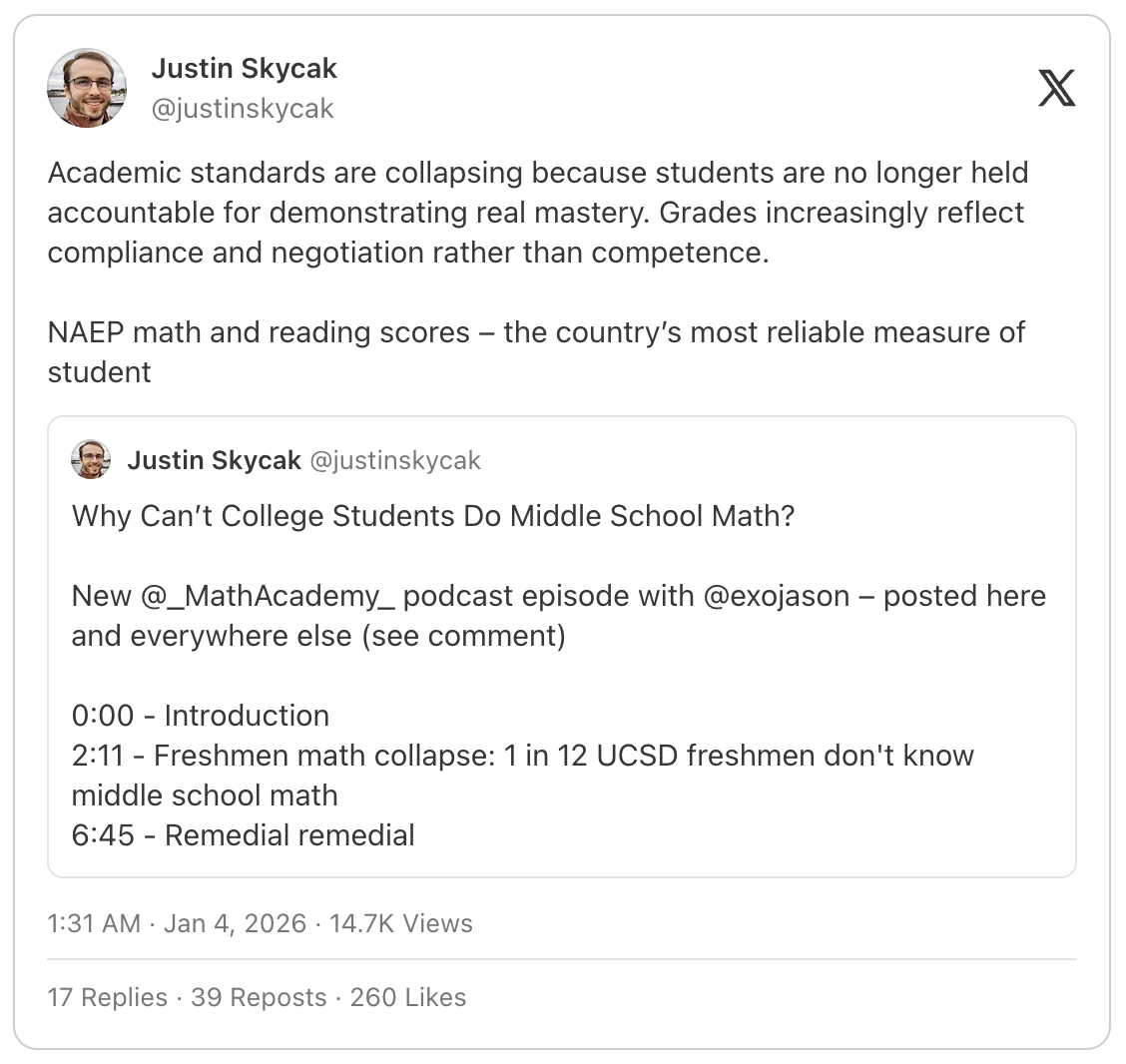
Exit exams were a foundational mechanism of the 1980s and 1990s as the accountability era gained steam and essentially spread through nearly every state.
Skycak is right about one thing, exit exams have almost entirely disappeared; they have been replaced in some states with end-of-course testing whereby a standardized test counts as a percentage of key course grades.
Here is the key problem with this naive view of exit exams: they didn’t work and even often caused harm (such as reducing student graduation).
Since the 1980s, many states have changed standards multiple times, including what should have been the tipping point with the monumental failure of the Common Core movement. Common Core didn’t transform US education positively, but it should have proven finally that standards/testing are not the problems.
This may sound cavalier, but honestly, standards do not really matter, and testing is much ado about nothing because standardized tests overwhelmingly reflect factors outside the walls of the school and conditions beyond the control of the students being tested.
Concurrent with the accountability era have been some compelling and enduring rhetorical responses to that evidence—no excuses, the soft bigotry of low expectations, and such.
Marginalizing anyone who acknowledges the fact that poverty and inequity are the primary causal factors in low student achievement (as measured by testing) is grounded in our cultural narratives—bootstrapping, rugged individualism—and not evidence. Yet, the ideological rhetoric is not just powerful, but it also supports public policy.
In the US, education reform is trapped in doing the same thing over and over while expecting different results—because the same thing is something sacred to our cultural beliefs.
Another reason we remain in this trap is that simple problems and simple solutions are far more compelling for political rhetoric and public policy that any sort of complexity or nuance.
Despite seeming to be obvious causal relationships, teacher quality is not very well reflected in student test scores, and as noted above, standardized test data are very weak reflections of student learning.
Therefore, the entrenched accountability model for education reform is inherently designed to fail—except if our goal is to keep education in perpetual crisis and reform (which does have a market benefit for the reformers and many politicians).
One interesting fact of NAEP data that tends to be ignored is that top scoring states, outlier scoring states (such as Mississippi, Florida, etc., in grade 4 reading), and essentially all states is that they all have about the same race and poverty gap as they did in 1998; for example, see the current model for reading reform, Mississippi:
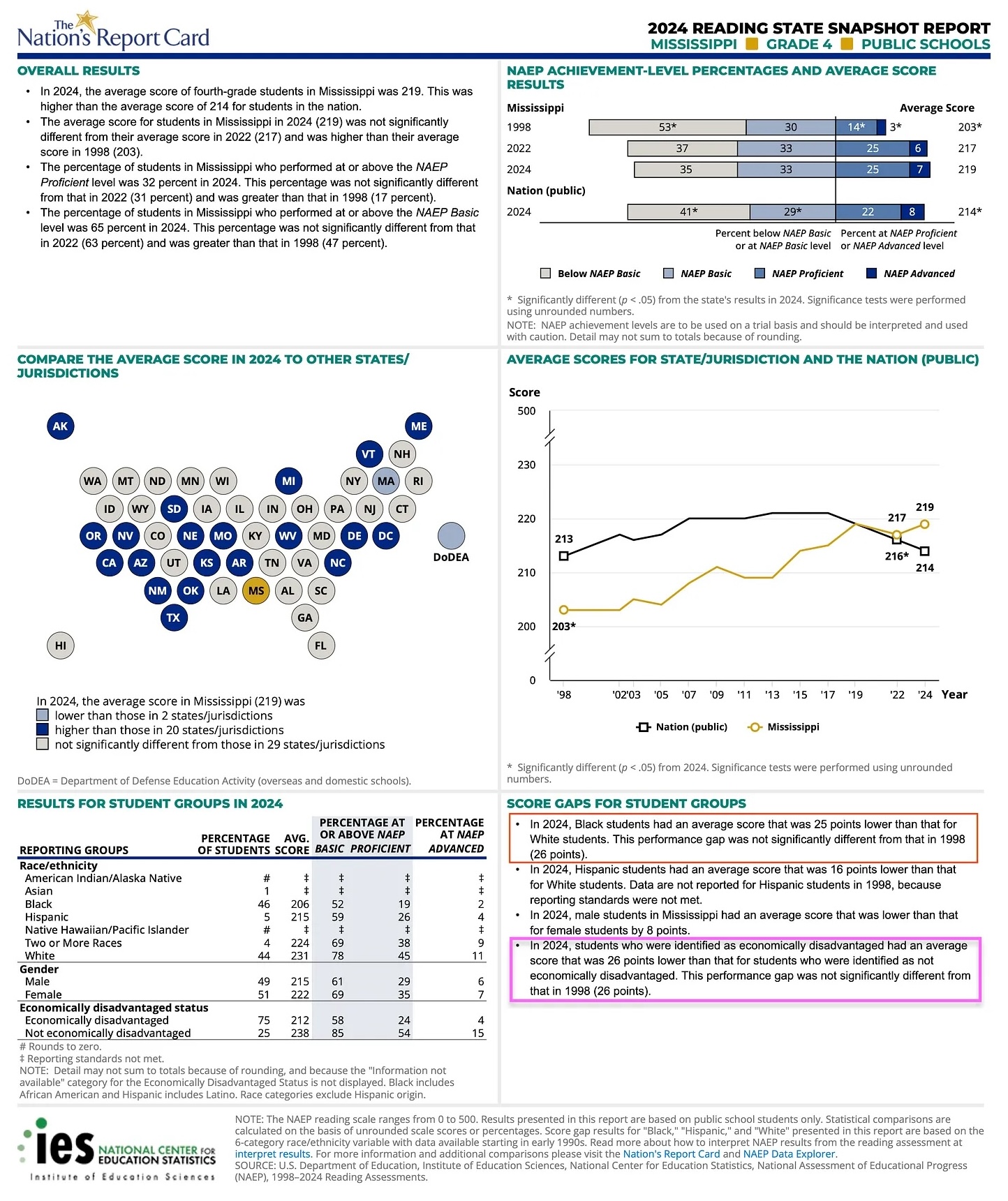
The nuance we need, and the nuance we persist in discounting, is to recognize that schools alone (regardless of the standards, regardless of the tests, regardless of teacher quality) cannot compensate for the outsized causal influence of social, community, and family factors grounded in all sorts of inequity (access to books, food insecurity, lack of healthcare, housing insecurity, etc.).
I, for one, have argued for decades now that we must do something different and that different must be grounded in evidence, not our corrupted and idealistic cultural narratives.
This blog post has been shared by permission from the author.
Readers wishing to comment on the content are encouraged to do so via the link to the original post.
Find the original post here:
The views expressed by the blogger are not necessarily those of NEPC.