Paul Thomas: Choosing "Changing the Odds" Over "Beating the Odds"
"One of the excuses educators have long offered to explain America's poor reading performance is poverty." Emily Hanford, Hard Words (2018)
Even in an era where the line between college and professional sports has essentially been erased, the US is poised once again to enter March Madness, the NCAA basketball tournament.
One of the odd dynamics about Americans’ love of this tournament is the conflicting excitement about “my team” winning and possibly the most compelling part of March Madness—the upset.
The underdog who defies the odds and slays the basketball Giant (you know, if only Duke can please lose, I don’t care if my team doesn’t).
However, in reality the odds of the upset are much lower than what most of us envision or even remember about previous tournaments.
Many of us of a certain age believe every year will see the Cinderella outcome of the stunning NC State championship in 1983 because the media has burned into our minds the image of Jim Valvano at the moment he realized his team had in fact won:

Watch on YouTube here.
If we love anything in the US, it is those who overcome the odds.
In fact, despite overcoming the odds being by its nature rare, an outlier, we have come to use that expectation as the norm—even (or maybe especially) for people with the least social, political, or economic power.
Like children.
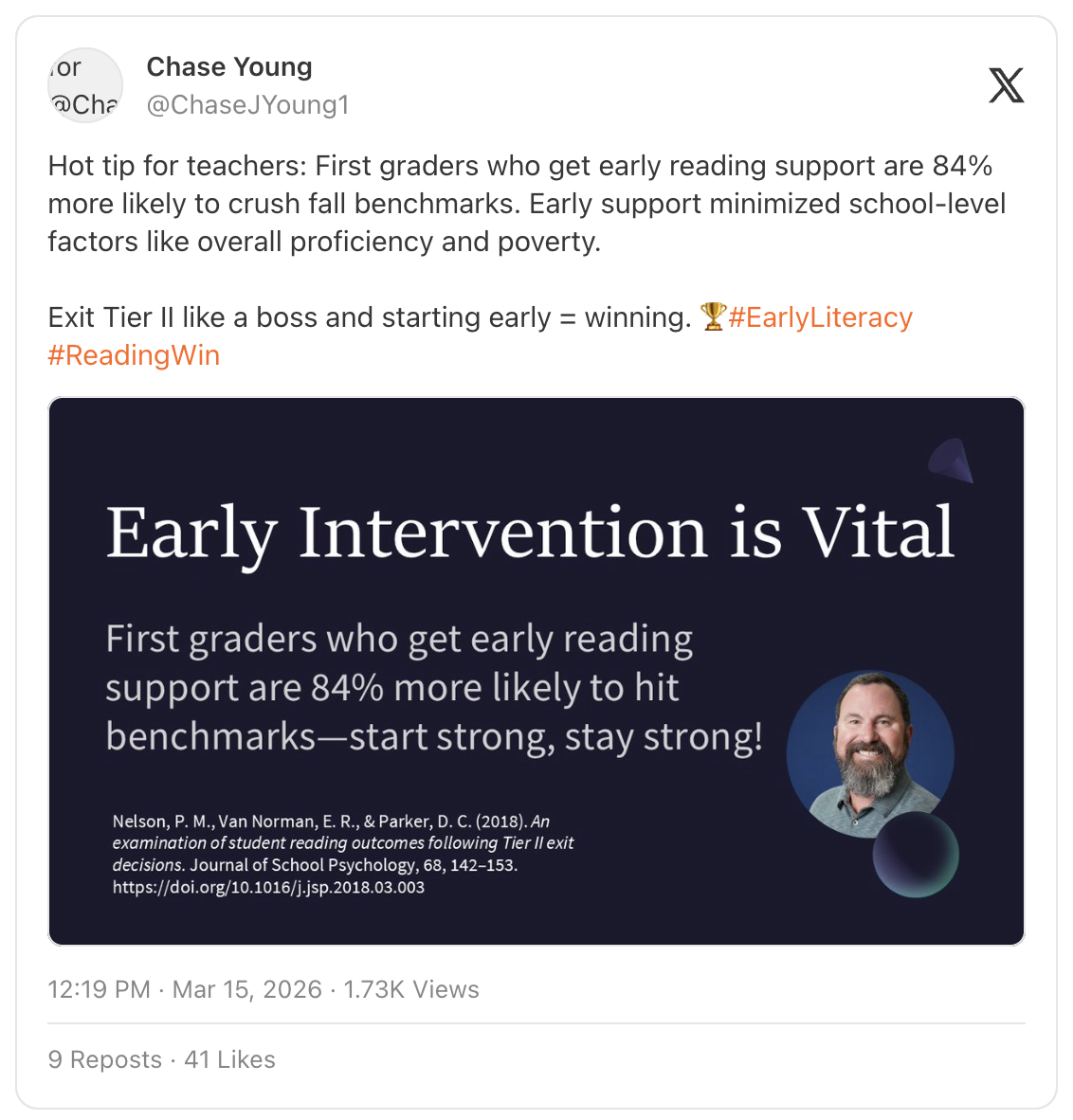
The fascination with beating the odds in education is widespread and usually is expressed in framing poverty as an “excuse” while also proving it is an excuse through anecdote—the “miracle.”
It’s the “See, there is no racism because Clarence Thomas is a Supreme Court Judge and Barack Obama was president!” approach.
If we circle back to the March Madness example, however, outliers do not prove a generalization; if fact, that something remains an outlier proves the opposite generalization, as shown in this 2024 analysis of the relationship between poverty and achievement:
Almost 63% of the variance in test performance was explained by social capital family income variables that influence the development of background knowledge. Background knowledge is a known predictor of standardized test results. Family income variables are immutable by schools. Only public policies, outside the control of school personnel, can influence family income.
The “no excuses” mentality in education is pervasive and bi-partisan, including political sources (George W. Bush and Arne Duncan), edu-gurus (John Hattie), and media messaging (Emily Hanford).
The result has been that education analysis and reform have been primarily in-school-only based on the equally false argument that education is a “game changer” (although data prove school mostly reflect and not change society).
Currently, then, the reform gaze is exclusively focused on Mississippi as yet another compelling but misleading “miracle,” proof that if we follow the “science” students and teachers can beat the odds.
Focusing on beating the odds distracts us from a more ethical and effective goal—changing the odds.
Note something different about the 2024 NAEP grade 4 reading snapshots from MS and the Department of Defense (DoDEA) schools:
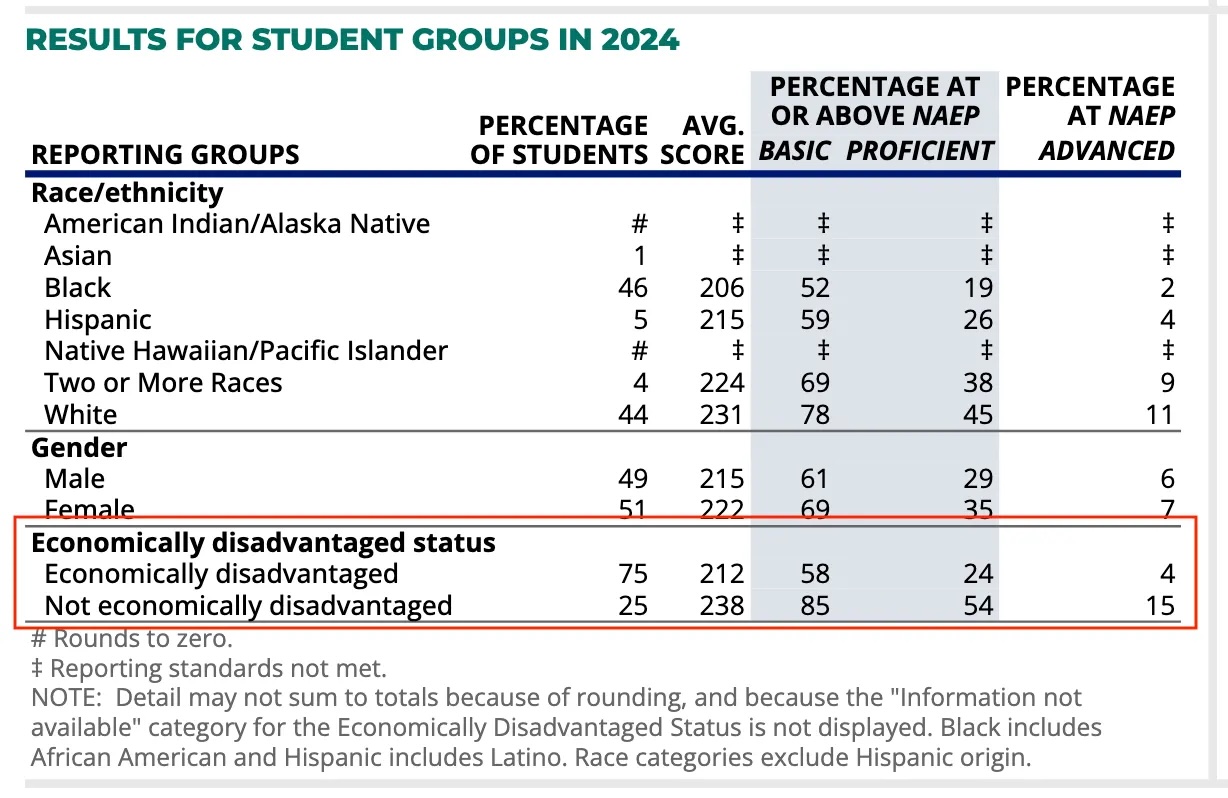
Mississippi
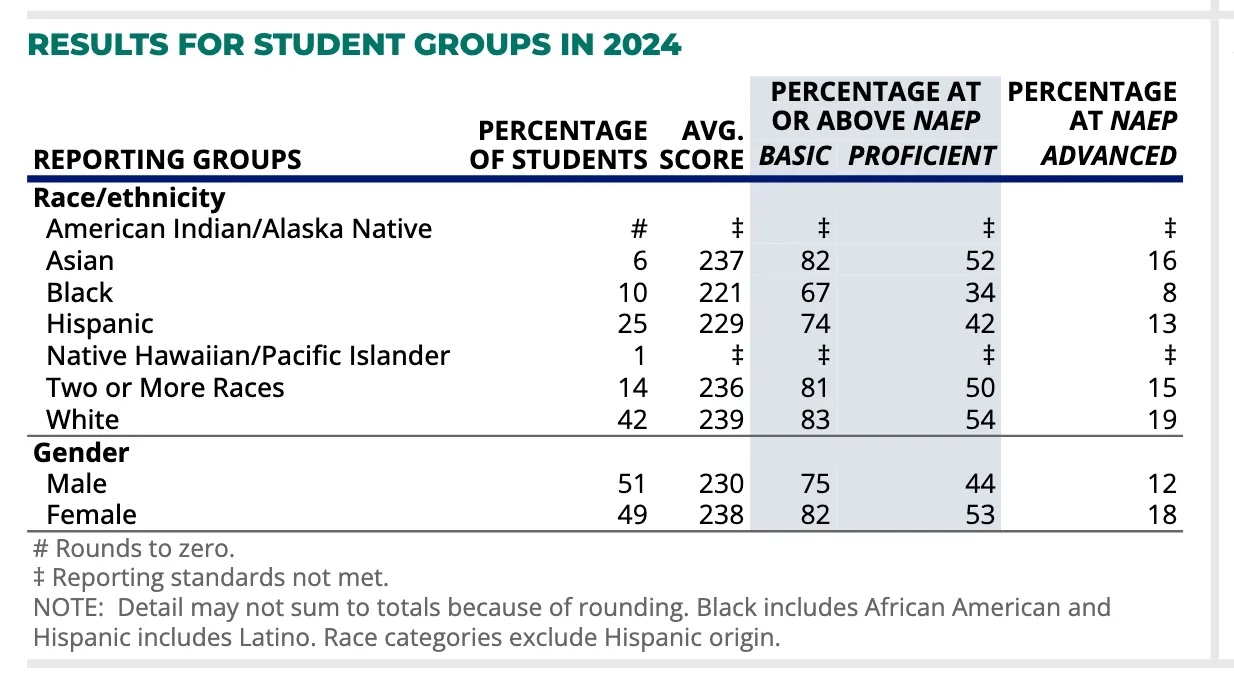
DoDEA
DoDEA has no students with economically disadvantaged status; and DoDEA Black students (221) significantly outperform MS Black students (206) as well as DoDEA students are the top performing students among all states in reading.
Those top DoDEA scores reflect not just reading proficiency but also that those students have medical care along with food, housing, and parental work security.
In other words, being in the military addresses factors “outside the control of school personnel,” as Maroun and Tienken demonstrate.
The ugly truth is that the US proves time and again that we can do whatever we have the political will to do.
Billions for war is a disturbingly easy choice. But poverty? Gosh, nothing we can do. Sorry.
Yet, our children are bombarded with ideological slogans—no excuses, grit, and growth mindset—teaching them that their success or failure is entirely within their ability to control, even if they must beat the odds.
In-school-only education reform and “no excuses” mindsets have failed for decades, and the evidence is clear that we should choose “changing the odds” over “beating the odds.”
Regretfully, the odds are not in our favor for that to happen any time soon.
This blog post has been shared by permission from the author.
Readers wishing to comment on the content are encouraged to do so via the link to the original post.
Find the original post here:
The views expressed by the blogger are not necessarily those of NEPC.