Gary Rubinstein's Blog: The74: Students In District That ‘Shed’ Remedial Math Thrived. The Data Suggests Otherwise.
I’ve been teaching Math for 35 years. And if I were to only be able to give a few words of advice to a beginning Math teacher, I would tell them: Don’t teach too much in one period. After all these years I’m pretty good at knowing what is the right amount of material to cover in one day but on a day where things don’t go well for my class, I always think “Next year I’ll split that up into two lessons.”
Learning Math is a slow and deliberate process. Especially with a current trend to have students more active in their learning, Math takes a lot of patience. And rushing through Math does not really serve any purpose. As there is no ‘end’ to Math, it’s not like someone who is a ‘year ahead’ or a ‘year behind’ their peers is really any closer or further away from the elusive end of Math.
So I had to take a breath before reading a recent article in the Campbell Brown anti-teacher education site The74. They nearly always get it wrong. One of the big claims of teacher bashers is that teachers have ‘low expectations’ for their students and these low expectations become self-fulfilling prophecies. I remember when the Common Core came out and I’d hear things like “the students are ready to be challenged more, now the teachers have to come on board.” The idea is that teachers are purposely teaching slow, presumably because the teachers are either too lazy to do the right thing or too dumb to know what the right thing is. If the teachers would just teach faster (more rigor) then the students would rise to that challenge. While I’m sure that there are some teachers out there who could teach more efficiently, this is not a very common thing. It is really in the teacher’s best interest to set an appropriate pace for their classes. Too fast or too slow can lead to problems.
So this article had the title “Maryland District Sheds Remedial High School Math Courses, Sees Students Soar” and the subtitle “Calvert County Public Schools reports major gains in kids successfully taking Algebra II, especially among Black students and those with disabilities.” To summarize the article: The district used to offer remedial classes before students took Algebra, then they got rid of those and had all 8th or 9th graders take Algebra and as a result, nearly all students in the district are succeeding in Algebra II while twenty years ago only 50% of Black students and 20% of students with disabilities had been.
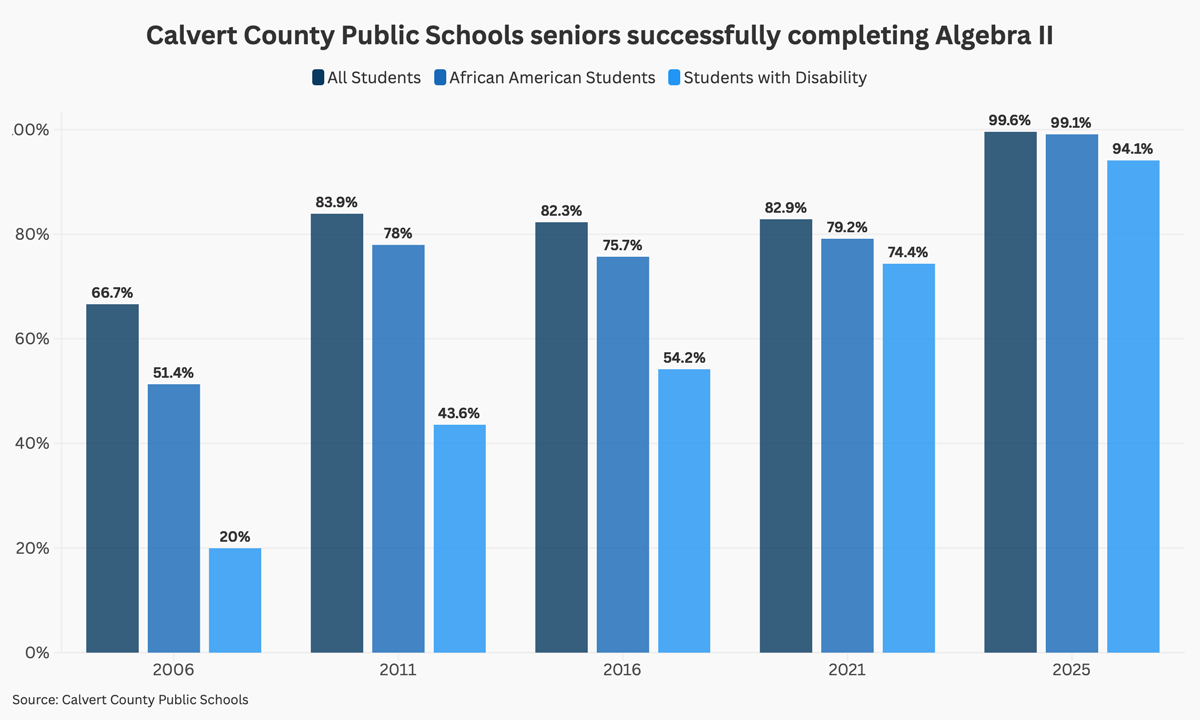
Since this contradicts my intuition after decades of teaching Math, I decided to look into the numbers beyond these bar graphs. There are only four high schools in Calvert County, Maryland. Maryland has a very accessible public data site and you can double check my numbers here if you want.
The state tests in Maryland are called the MCAP tests and they offer them for the high school math sequence Algebra I, Geometry, and Algebra II.
For reference, the Maryland state proficiency percentages on them are 21.4% for Algebra I, 27.5% for Geometry, and 24.5% in Algebra II. When I see these numbers I would like to see the actual tests since low numbers like this could mean that the cutoff score is too high. Or it could mean that the tests are unnecessarily difficult. Or it could be that the students don’t know the Math very well.
So I looked up the results for the four schools in this district that had cut remedial math courses:
Calvert High had 5% Algebra I, 6.7% Geometry, and 5% Algebra II.
Northern High had 10.7% Algebra I, 25% Geometry, and 21% Algebra II.
Huntingtown High had 11% Algebra I, 23.2% Geometry, and 23.2% Algebra II.
Patuxent High had 6% Algebra I, 10.6% Geometry, and 19.3% Algebra II.
So even by the low baseline score for the State, these scores are always lower than the state average.
When I looked at these MCAP scores filtered by race, the data looked even worse. This is a graph for Calvert High for the past four years broken down by all students and by Black students. For 2025, the percent of Black students scoring proficient seems to be zero.
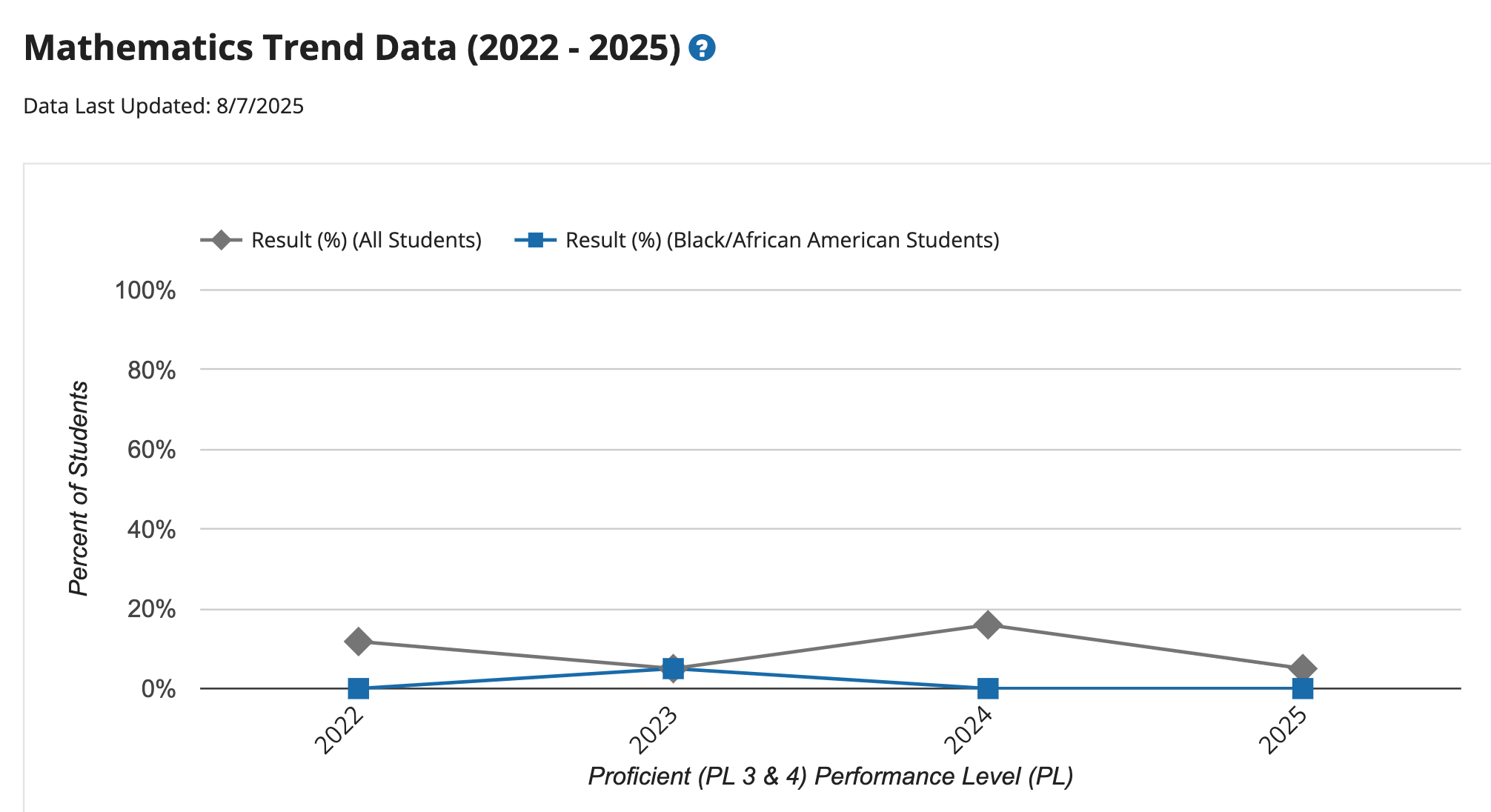
So what data was The74 using to support the thesis that low teacher expectations are to blame for low advanced Math test scores? Those numbers all near 100% are the number of seniors ‘completing’ Algebra II. But as can be seen from the MCAP scores, ‘completing’ is not the same thing as ‘learning.’ So it is unfortunate that so many students have to be forced into Math courses they are not ready for just so a district can claim that students always rise to higher expectations.
I think the one of the issues is that the term ‘remedial’ Math has such a negative connotation. There is nothing wrong with a Math course that is at a student’s level, just as there is nothing wrong with a low-impact aerobics class or running a Marathon at a 5 hour pace if that’s where you’re at.
The people who should be taking remedial Math are clearly the staff of The74.
This blog post has been shared by permission from the author.
Readers wishing to comment on the content are encouraged to do so via the link to the original post.
Find the original post here:
The views expressed by the blogger are not necessarily those of NEPC.