First Fish Chronicles: The Price Kids Pay: What Alpha School Really Costs
What happens when we let EdTech run a school.
As we continue The Reckoning, this essay looks at where education may end up if we allow an EdTech and AI company to run schools. This week’s focus is Alpha School, an “up and coming private school model” whose self-serving mission is to “transform” K-12 education. Alpha School has been written about in many news outlets (see links below), so our main goal here is to illuminate the extremely close (and very uncomfortable) ties Alpha School has to companies and people who have nothing to do with education and everything to do with advancing specific technology products for profit. Per our usual.
About Alpha School and How it Differs from “Regular” Schools
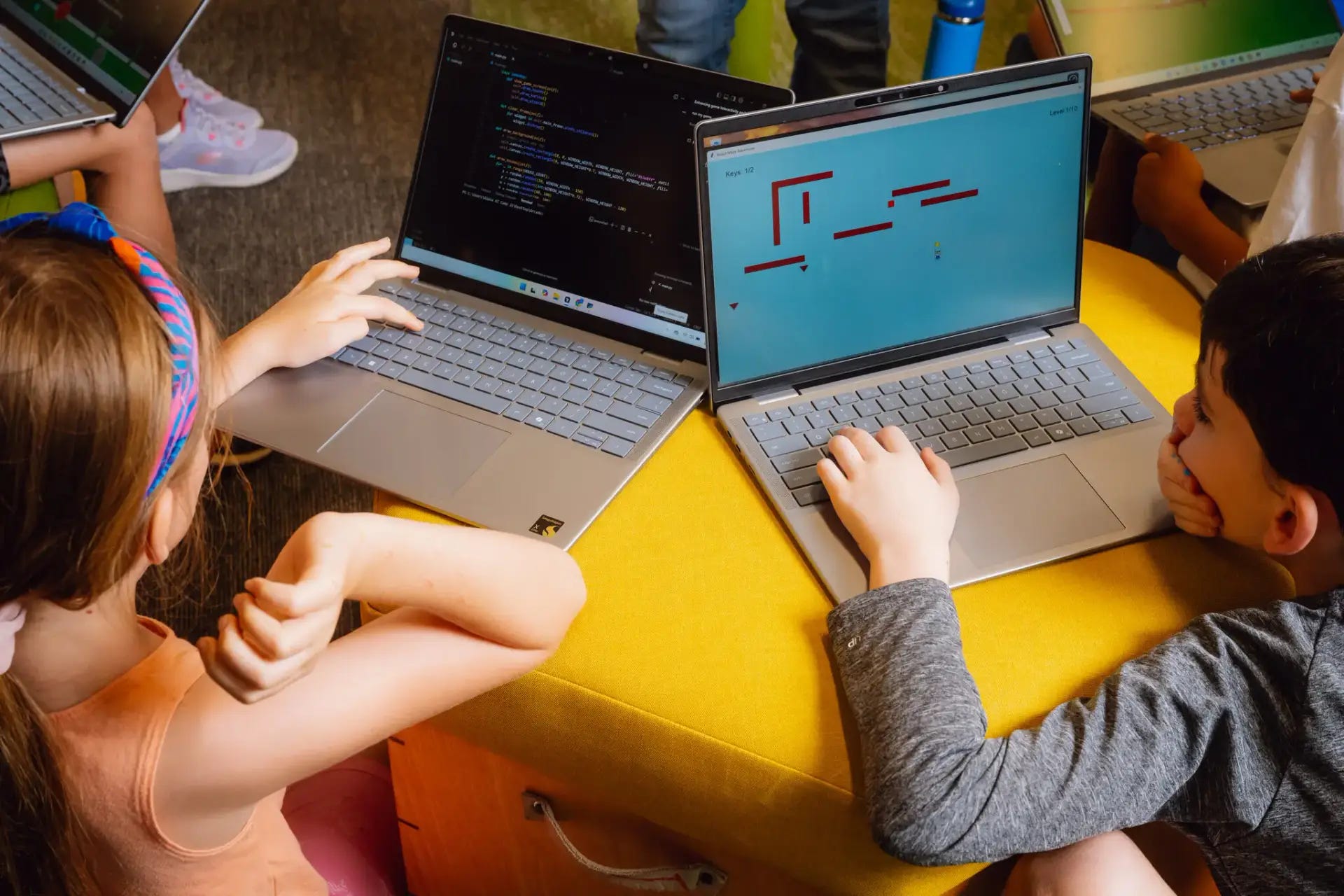
Alpha School’s co-founder and spokesperson, MacKenzie Price, would have you believe that kids can experience “twice as much progress” in just two hours a day working on Alpha’s proprietary AI-generated personalized education platform (Timeback and “2-hour learning”, whose website refers to the product as an “AI tutor”) as they would in a traditional education setting. After students “crush” academics in two hours (their verb, not ours), students are free to spend the rest of their school day engaged in skill-building, real-world activities. Which, ironically, has enormous benefits. The price tag to attend one of Alpha’s schools around the country varies based on location, with some families paying between $40-60K a year in tuition, or even as much as $75K according to this recent news story.
Whether or not one thinks AI-based education is a “good” way to learn (and we don’t), this essay is about the insidious attempts by powerful tech industry titans to assert they know more about educating children while profiting off the hot air they blow about their products.
Price started her “2x learning in 2 hours” education program after her daughter expressed that she was “bored” at school. Like many of us, Price was a mother seeking a better educational experience for her child. Price is also a great saleswoman and a rising “ed-fluencer.” If you have seen her social media accounts (where she fear-mongers to 1.2 million followers on Instagram while deriding public education and offering her program as the “solution,” naturally), she touts Alpha School as the “Future of Education.” While Price holds a B.A. in Psychology from Stanford, she is not an educator herself and does not appear to have worked as an educator prior to starting her school.
Interestingly, Alpha School famously does not hire actual educators. The adults who work with students at Alpha are called “guides” and only one-third of Alpha guides have educational training or degrees. (Ironically, Price laments that “teachers are leaving the field in droves” because they are “underappreciated and overworked and underpaid, but she doesn’t seem to hire them or want to even describe the adults she employs as such. Alpha guides make six figures, which is leaps and bounds more than a traditional public school starting salary of around $40-50K, depending on the state).
(Side note: As educators ourselves, we find it particularly offensive when non-educators decide they can “improve” education. Imagine if we designed surgical tools then marched into the operating room and demanded of the surgeon that she allow us to perform the surgery. If you were that patient, would this be okay with you? We think not.)
Source: Alpha School website
Alpha School Might Work for a Few Children, But at What Cost?
Alpha School started as a network of private schools, catering mainly to wealthier families, ostensibly leaving parents the choice to send, or not send, their children there. But Alpha School founders have a much bigger goal and have extended their reach into poorer, less advantaged communities like Brownsville, TX, where parents may lack the privilege, time, and resources to question Alpha’s intentions or challenge its business models. And according to their website, Alpha School’s vision is to “scale this revolution globally…to build the next generation of highly effective, for-profit educational institutions.” (Unlike public education, “for-profit” institutions can determine which students they accept or don’t.)
A few students might benefit from an educational model like Alpha’s (though we’re curious to know how much of their “success” is due to advanced cognitive abilities before entering the program, additional support of their families, or from the benefits of the other four hours of the Alpha School day that is focused on “life skills”). Alpha School’s website is vague and doesn’t divulge which educational technology apps are used by students, so it is difficult to assess what the curricula actually is or how it works. However, reports have suggested IXL, Khan Academy and Trilogy AI are among their programs– online adaptive learning tools that are also currently used in many school districts across the United States. The difference is that Alpha School seems to think using these programs daily equates to “learning 2x faster.” Price takes programs that are already being used in public schools, rebrands them, and charges a hefty tuition.
“Learning 2x Faster” is a Marketing Gimmick and the Math Isn’t Mathing
Do kids really magically learn 2x– or 10x, as they claim on some pages– faster in Alpha School, or is this just a great sales pitch?
According to Alpha’s website, an AI-driven platform “delivers personalized academic lessons, allowing students to learn approximately 10 times faster than in a traditional setting,” allowing students to “master a full year of material in just 20-22 hours.” By “completing their academics in two hours a day,” students gain their “time back” to focus on a “life skills curriculum covering leadership, teamwork, grit, and entrepreneurship.” But the science of learning is much more complex and nuanced than Price will lead you to believe.
We asked educational neuroscientist Dr. Jared Cooney Horvath, author of The Digital Delusion: How Classroom Technology Harms Our Kids’ Learning– And How to Help Them Thrive Again, about this “2-hour learning” claim and he told us: “If learning could truly be accelerated at the rates claimed by Alpha schools, then students would finish a complete K–12 education by the second year of elementary school - an obviously absurd implication. EdTech developers have long promised faster and easier learning. But speed and ease have never been the hallmarks of deep education. Real learning is slow, effortful, and deliberate.”
Dr. Horvath also pointed out to us that this isn’t the first time people have conflated “moving through content quickly” with “learning.” He says there is “no question schools could move through content more quickly. But that confuses the purpose of education. We are not here to clear curricula or pass tests - we are here to learn how to ‘think through knowledge’ and ‘transform ideas’. The time students spend revising ideas, debating them, and applying them across varied contexts is not wasted time. That is learning.”

Source: Alpha School website

As educators ourselves, we know that telling parents their kids can “learn twice as much, twice as fast” (or 10x as much) is misleading at best. But Price also makes it difficult to find the data to back her claim that her students regularly test in the 99th percentile. For example, Alpha School uses the NWEA MAP to measure progress. MAP (Measures of Academic Progress) uses a computerized adaptive assessment format to measure a child’s knowledge in reading and math. Scores from the MAP assessment are not considered standardized because the test is adaptive and different for each child. As a child progresses, the test adapts to how a child responds and the difficulty adjusts with the child’s performance. Unfortunately, schools are allowed to modify their preferences when interpreting data which can inflate scores and performance. However, as one digital media researcher pointed out in this essay:
[Alpha School’s] claims are “based entirely on an internal analysis of NWEA MAP test data and haven’t been independently verified by third parties. Critics have also challenged the statistical methodology, alleging use of ‘inflated MAP growth ratios’ and ‘misused medians’ to produce impressive but potentially misleading results.”
We’re not the only ones noticing this questionable interpretation of test data– Alpha School’s performance claims led the State of Pennsylvania to reject their proposal to initiate a charter school in the state.
You Should See the List of Personal Data that Alpha Schools Mines About Their Students. It’s Horrifying.
Even if you buy into the notion that children can (or should) “learn” just as much in two hours via a chatbot as they can from a human teacher (and we don’t), there is a steep cost to users of Price’s Alpha School platforms when it comes to personal data, and our hunch is that most Alpha School parents have zero idea of what is actually being collected about their children, even if they’ve checked a box during registration (which also begs the question of whether or not this qualifies as Alpha schools getting informed and meaningful parental consent).
We read their privacy policy, and it’s really, really bad.
Alpha School– to be fair, like many EdTech companies say– says they “need” to collect extensive personal information about their students. In order to “support the educational success of the company,” Alpha Schools rely on “extensive data collection and analysis” to assist with “achieving the results desired” and to “improve a student’s performance.” This is the what it means to “personalize learning,” but how that sausage gets made entails collecting a vast amount of personal information, such as:
-
Academic and cognitive test scores
-
All group, 1:1, and online meeting sessions (audio and video), such as Zoom calls
-
Screenshots taken while a student is working
-
Keyboard and mouse activity, to “determine if the student is idle”
-
Webcams, microphones, and online meeting tools “may be used to record the student”1
-
“Continuous webcam video” to help “identify eye contact and body language to help detect engagement and focus issues, as well as identifying environmental distractions”
-
Productivity may be tracked to “display on a leaderboard” or “provide rewards”
-
If the student redeems those rewards, the “purchase or other history related to redemption of those rewards” will be tracked as well
-
A student’s biometric data, information, and identifiers
-
A student’s geolocation2
-
Any websites or apps students access
-
Student answers and grades on any learning apps are recorded
-
Constant surveillance in the form of continuous video of student screen activity to “help identify learning behaviors” or “prevent cheating”
-
Screenshots and recordings are “monitored 24x7”
That’s not all. Alpha also states they “may collect other data in the future,” such as if a student has poor sleep habits, they can “track sleep” to “suggest improvements” (they are not doctors) or if students are learning meditation, “a headband monitor and app” may be used to collect data for “analysis.”

Photo by Alan J. Hendry on Unsplash
Parents should not expect to be able to opt out of much of this, even if they know to or want to. Alpha’s privacy policy stipulates:
“If you [parents] exercise an option to opt-out of particular data collection on your student’s computer your student may still be subject to recording on another device where the parent has not exercised the right to opt-out, in particular while at school (when applicable) in the proximity of a large number of device cameras and microphones.” Nor should parents expect or assume privacy while at school again because of “the number of cameras and microphones on computers that may be recording.”
Why should we care about children’s privacy? Because when our right to privacy is weakened, the erosion of other rights soon follows.
Looking Behind the Curtain at Alpha School
Mackenzie Price’s background is not in education and neither is her co-founder’s and funding partner, Joe Liemandt. Liemandt is the founder of a company called Trilogy and owns a private equity company called ESW Capital. He is worth $6.6 billion. In 1998, Mackenzie Price was recruited to work at Trilogy in marketing and business development where she met her husband, Andrew, the CFO. Liemandt and Price were so close that he was the best man at MacKenzie’s wedding to Andy Price in 2004, and each family had two daughters who grew up together.
Joe’s optimism for the future of education and Alpha School rests on the Timeback platform, the ”AI-powered EducationOS behind Alpha schools” that is launching in 2026. Timeback’s website (yes, there is yet another website) states that their product is “built on learning science” and claims that “independent standardized tests confirm learning gains up to 10x faster” but do not link to or offer any supporting documentation. We have a feeling Dr. Horvath might want to see where their research comes from.
Alpha School’s website says this about Joe:
“Joe Liemandt, the AI pioneer who founded Trilogy, is reinventing K-12 education with Alpha School, … His vision is to scale this revolution globally with the Timeback platform, a ‘Shopify for schools’ that empowers entrepreneurs to build the next generation of highly effective, for-profit educational institutions.”
In an August 2025 profile in Colossus,3 a publication that profiles investors, founders, and companies, the author notes that Liemandt’s “explicit aim” is to “make Price’s vision accessible to every child on planet Earth.” Liemandt is certain that “Timeback will…succeed by providing thousands of other people with a way to build their own schools, their own education products, and their own motivational models to get Alpha’s results.”
“Education is a multitrillion dollar industry with no good products that you can’t donate or tax your way out of,” Liemandt says. Their product will “create dozens of unicorns that create hundreds of products that let kids crush, completely crush academics in two hours a day. And then reclaim their childhood.” Of course, there is no way for us to see what, exactly, Timeback is or entails, because the website is vague and nonspecific, likely intentionally so.
Price, Liemandt, Alpha, and Timeback– they’re saying the quiet part out loud: the goal is not to help children or improve education; their goal is to scale their business and their product. Timeback is the operating system above a “core generation engine” called “Incept”-- whose name Liemandt says is partially influenced by the Christopher Nolan movie “Inception”4-- and Liemandt’s interpretation of the meaning of “incept” reveals what he really thinks about education: “It’s putting a mind virus into a kid’s head, which is what education is. And it’s being done by a teacher you trust.”
 Source: https://colossus.com/article/joe-liemandt-class-dismissed/

As a reminder, there are not “teachers” at Alpha School, only “guides.” The “teacher” here is the large language model on which Alpha’s proprietary methods are based.
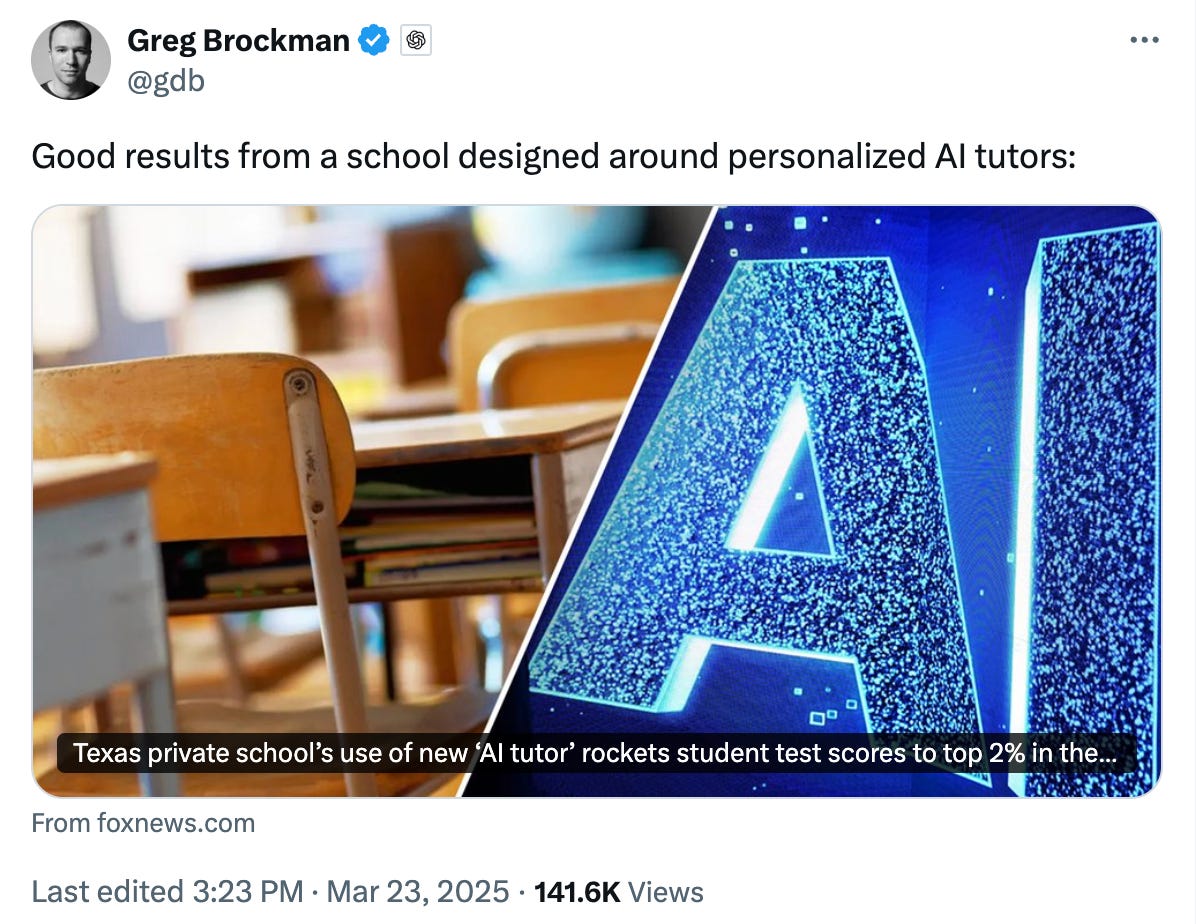
A lot of other very influential (non-educator) people extol this effort. Alpha School has drawn praise from big tech titans like Greg Brockman (cofounder and president of OpenAI) and Peter Diamandis (founder of XPRIZE, where Elon Musk sits on the board, and Singularity University, not an accredited university), among others. Billionaire hedge fund manager Bill Ackman and LinkedIn cofounder Reid Hoffman praise the school’s “innovative design.”
More recently, Geoffrey E. Hinton, who is widely regarded as the ‘Godfather of AI’ and served as PhD advisor to Ilya Sutskever, co-founder and Chief Scientist of OpenAI,5 offered his own praise of Alpha Schools. In a press release put out by Alpha Schools (they are very savvy marketers), the headline reads “Alpha School Recognized by Nobel Laureate and ‘Godfather of AI’ Geoffrey Hinton as a Beacon of Optimism in the AI Era” and even though the document acknowledges that Hinton himself has made “well-documented warnings about AI’s potential for harm,” Hinton caves: “When done right, [AI] can tailor learning to each student, offering what many human tutors strive for but rarely achieve at scale.” The goal of Alpha School isn’t to help children; it’s to scale education.
Price loves Hinton’s praise of Alpha, saying that “the fact he acknowledged Alpha Schools as a beacon of optimism in this rapidly changing world is humbling and a sure sign credible voices are recognizing AI’s power to transform learning so that kids can reach their true potential.”
Of course, the endorsement of Alpha School by Hinton himself is dubious. Why would he say this if he has offered significant warnings about the harms of AI as recently as November of 2025? He is clearly a brilliant academic. But like many academics in this day and age, Hinton is both a scientist and a company man. In 2013, according to Karen Hao in her book The Empire of AI: Dreams and Nightmares in Sam Altman’s OpenAI, Hinton blurred academic ethics by “only joining Google on the condition that he simultaneously keep his position at the University of Toronto.” As more professors, especially those in the field of AI research, began to maintain “dual affiliations” with both a company and a university, the “practice began to erode the boundaries of truly independent research.” Such dualities allow tech funding to further influence the research being done on their own products. Talk about a conflict of interest.
In fact, just this past December, the University of Toronto, where Hinton teaches, announced they were establishing the “Hinton Chair in Artificial Intelligence” and would donate $10 million to fund it.
Google is contributing an additional $10 million.

Source: University of Toronto website, photo by Nick Iwanyshyn
Coming to a School Near You: One Final Reason to Worry
This past fall, U.S. Secretary of Education Linda McMahon visited Alpha School during her Returning Education to the States Tour while in Texas. After her tour, she reportedly met with school leaders, including Mackenzie Price, for “a roundtable discussion on AI and innovation.” Considering the current Trump administration’s Executive Order to put AI in the hands of children and the American Federation of Teachers’ new $23 million National Academy for AI Instruction,6 funded by Microsoft, Anthropic, and OpenAI, we are very concerned about this budding relationship. No doubt the administration’s push to use AI would be very profitable to the Alpha School model despite no independently funded research data to support their product is beneficial for children (and indeed may be harmful). Not surprisingly, Alpha Schools is one of 202 organizations thus far that has signed the White House Pledge in support of investing in and expanding AI.
We’ll close with this: at the very end of this recent Today Show story on Alpha Schools, NBC reporter Nicky Nguyen comments, “The day we were [visiting Alpha School] there were multiple public school administrators on campus as well, receiving a tour and asking questions about how to best incorporate AI learning tools into a classroom environment.” It’s almost said as an afterthought, but we think it should be the main headline.
Administrators should be asking a lot of questions about the presence of AI in education, but we sure don’t think AI-evangelists ought to be the ones providing the answers. Before we allow Mckenzie Price (and Timeback and Incept) to take over our children’ s education, we should first answer the question:
What does Alpha School really cost, and are we willing to pay that price?
1 In their privacy policy, Alpha School offers a professional sports analogy– and this wording is their own— “This [recorded data] is game film” to allow “analysis, instruction, and improvement of both learning and instruction”
2 Students on the Austin campus are tracked “in the school building” to track locations, “analyze children’s social skills,” and for “student safety.”
3 We highly recommend reading this in-depth interview with Joe Liemandt in Colossus called “Class Dismissed” for more information: https://colossus.com/article/joe-liemandt-class-dismissed/
4 The plot of "Inception" as inspiration for this tool isn't great. Wikipedia summarizes the film as such: "Dom Cobb and Arthur are 'extractors' who perform corporate espionage using experimental dream-sharing technology to infiltrate their targets' subconscious and extract information."
5 OpenAI is partnering with the American Federation of Teachers to launch the National Academy for AI Instruction. Source: https://openai.com/global-affairs/aft/
6 It is revealing that in this press release put out by the American Federation of Teachers, the first quote is not by the AFT president Randi Weingarten, but by the president of Microsoft.
This blog post has been shared by permission from the author.
Readers wishing to comment on the content are encouraged to do so via the link to the original post.
Find the original post here:
The views expressed by the blogger are not necessarily those of NEPC.