10th Period: State Data: Ohio Spent More on School Privatization Last Year Than Public Schools in Many Communities
This is getting ridiculous.
Ohio lawmakers and governors have so overvalued failing Charter Schools and unconstitutional private school tuition subsidies that in some communities state taxpayers are paying more to educate students in privately run schools than local public schools1.
Columbus — Ohio’s largest school district — is the poster child for this phenomenon. Last school year, Ohio sent Columbus City Schools $166 million to educate the district’s 41,587 students. Meanwhile, the state sent $328 million to pay for the 30,085 students enrolled in Charter Schools and private schools.
That’s right.
The state paid these privately run schools in Columbus (and online) nearly double what they paid kids in the state’s largest public school district.
That’s obscene.
But it’s not unique.
There are 26 Ohio school districts where the state’s sending 75 percent or more of the amount of funding to privately run schools than students in the public schools. On avergae, the state is sending 20 percent of the funding it sends to students in public schools to failing charter schools or to subsidize the unconstitutional private school voucher program.
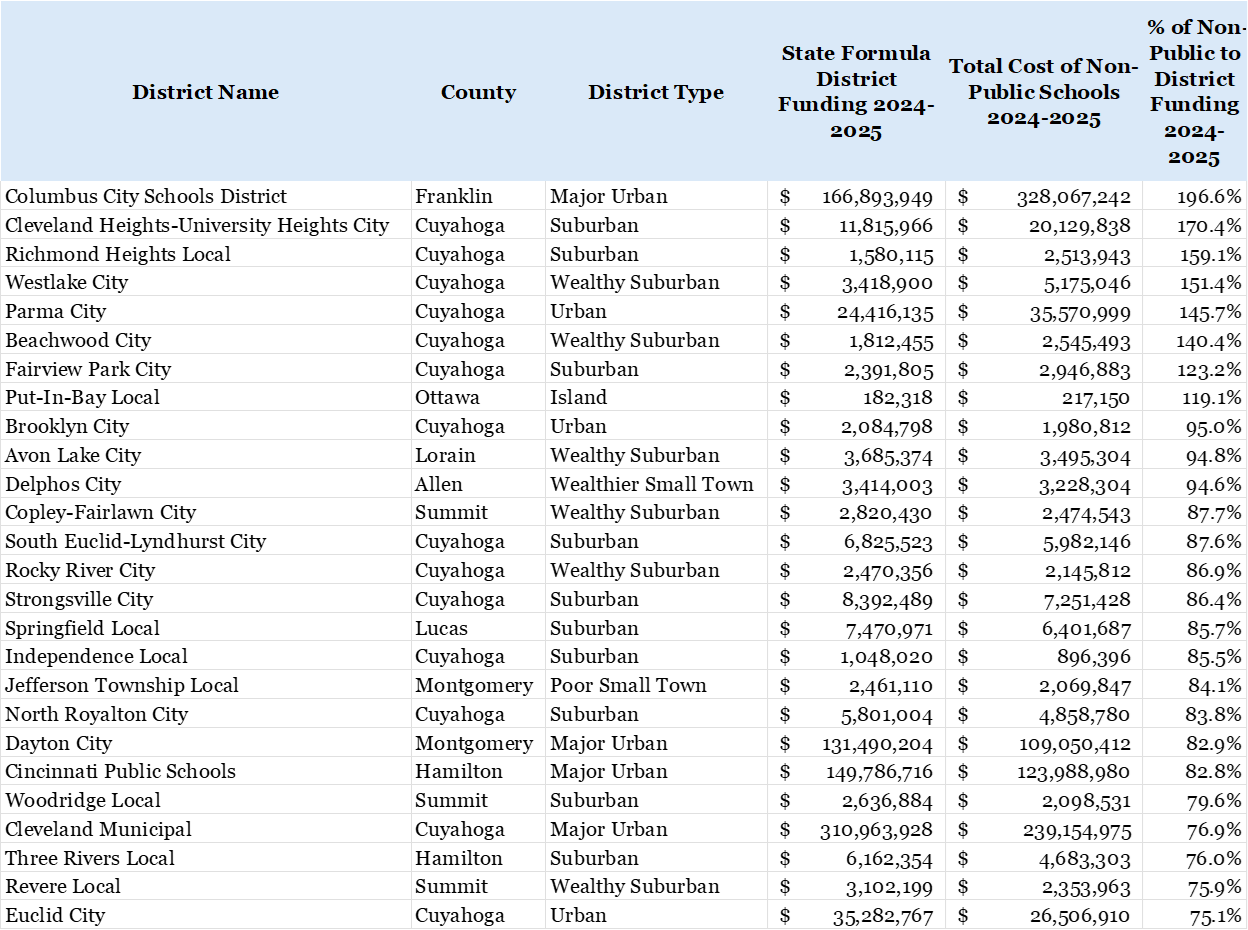
What else do you notice? It’s not just big urban districts like Columbus and Cleveland where you’re seeing this phenomenon. Rich districts like Westlake, Revere and Rocky River are witnessing this too. Even little Put-in-Bay has more money going to privately run schools2 than the local public school district. In fact, the phenomenon is most pronounced in wealthier suburban districts3.
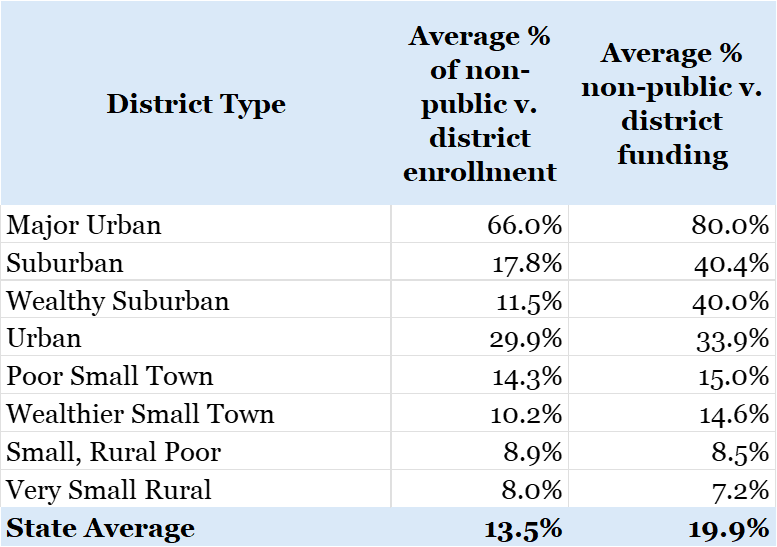
Look at the state’s wealthiest districts. Even though barely 10 percent of the students in those districts on average attend failing Charter Schools or have parents who receive unconstitutional private school tuition subsidies, the state is sending about 40 percent of the revenue it sends to the district to those privately run schools.
But, of course, the districts hurt most emphatically by this phenomenon are the state’s eight major urban districts — Akron, Canton, Cincinnati, Columbus, Cleveland, Dayton, Toledo and Youngstown. On average, those districts see the state send 80 percent of the money they receive for their own students to largely unaccountable, privately run schools.
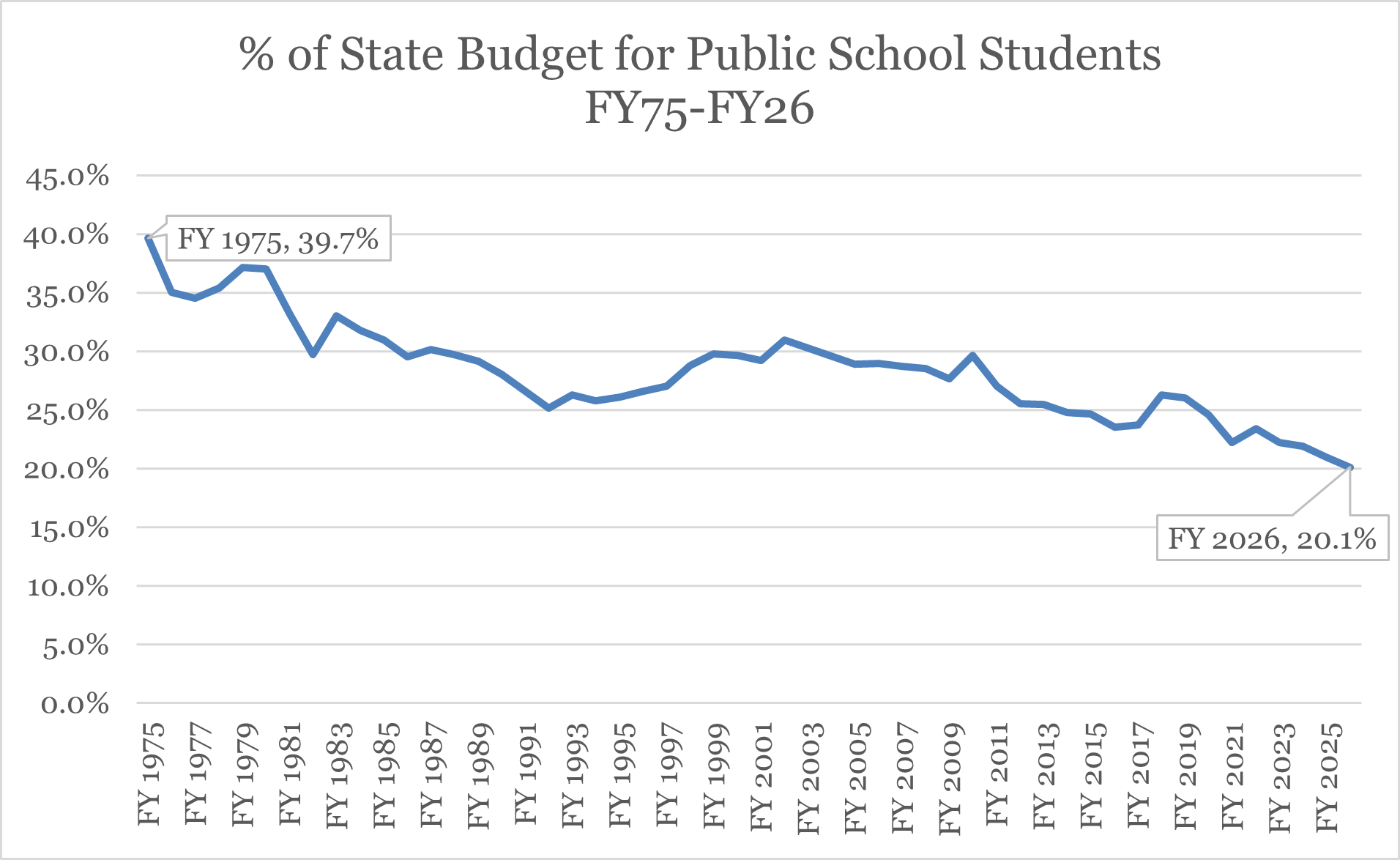
Once again, this overvaluation of privately run schools in Ohio helps explain why the state now spends about half the share of the state’s budget on the state’s 1.5 million public school students as it did in 1975.
Truly alarming.
Perhaps politicians in this election year should be asked how they’re going to fix this?
Seems like a fair question to me.
1 And it’s probably worse than what I’m reporting here. That’s because this analysis only includes payments made to Ohio Charter Schools and the EdChoice, Cleveland and EdChoice Expansion programs, which subsidize private school tuitions for mostly wealthy adults like Les Wexner. I did account for cost differences between the online and site-based Charter Schools, as well as the different per pupil costs in EdChoice and EdChoice Expansion. Cleveland’s per pupil amount is only a few dollars less than EdChoice. I am not including tuition subsidies for the special education and autism vouchers ($264 million total) because the state’s school options spreadsheet combines those two programs and their costs are so wildly divergent that parsing them out is near impossible. Nor am I including administrative cost reimbursement ($75 million), auxiliary services ($164 million), or busing costs that privately run schools receive as well.
2 I know charter school people will lose it over this characterization of their schools being privately run. However, every time that a teacher’s union has tried to organize in a Charter School, the National Labor Relations Board asserts jurisdiction. Why does that matter? Because the NLRB oversees organizing efforts in the private sector, not the public sector. So the NLRB found tat Ohio charter schools are private, not public, employers. Several years ago, the state forced all organizing efforts to go through the State Employment Relations Board (SERB) after Charter School teachers in Cleveland went through the NLRB to get their certification. But not because they’re actually publicly run schools. Charter School advocates want to pass off their schools as public. Which they are not in the most important ways.
3 Always feel the need to point out that these district types are determined by the Ohio Department of Education, not I.
This blog post has been shared by permission from the author.
Readers wishing to comment on the content are encouraged to do so via the link to the original post.
Find the original post here:
The views expressed by the blogger are not necessarily those of NEPC.