10th Period: State Spending on Public School Students Lowest Since 1997
After I dealt with the Buckeye “Institute” argument claiming that Ohio’s spending more on K-12 education than ever so school districts should quit whining about their funding, I thought I should expand my look at inflation-adjusted K-12 education spending beyond Buckeye’s arbitrary starting point of 2010.
I wanted to answer this simple question: What year since 1975 has the state spent the closest to last year’s amount on its public school children, adjusted for inflation?
Would it surprise you to learn that last year’s amount is the lowest spending amount since 1997 — the year the state started using taxpayer dollars to subsidize private school tuition?
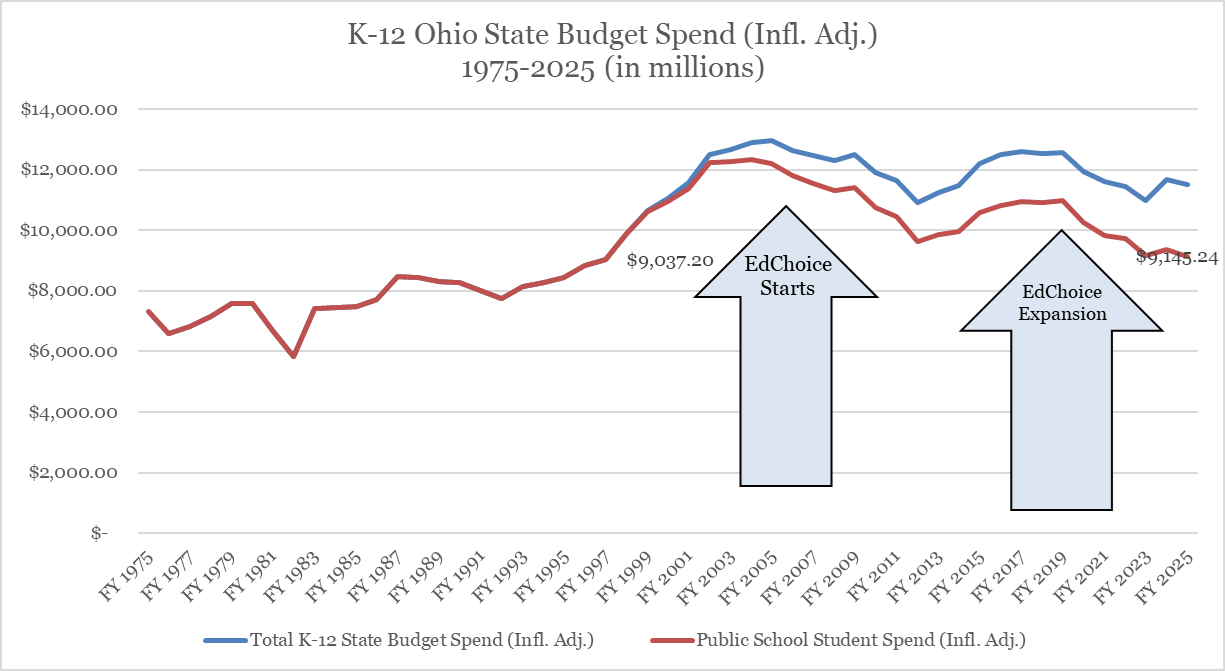
Would it also shock you to learn that the amount spent on K-12 public school students has dropped a whopping 16% since Ohio broke open the unconstitutional EdChoice voucher program to make it universal in 2019?
Yeah. Didn’t think so.
What the data show clearly is that almost every additional dollar going to the state’s K-12 funding since the state started the voucher program in 1997 has gone to fund kids who don’t attend the state’s public schools1.
The money has instead funded notoriously poor performing, privately run charter schools or unconstitutionally subsidize private school tuitions of students who, in the overwhelming number of cases, never stepped foot in the public schools.
This is one of the reasons why Ohio’s EdChoice program has been ruled unconstitutional — because it has meant that the state has essentially flat funded public school students over the last 28 years while providing billions of dollars to subsidize private school tuitions — not a penny of which has ever been publicly audited.
What year did public school students receive the most state aid, adjusted for inflation?
The 2003-2004 school year — the school year immediately after the fourth and final Ohio Supreme Court ruling that found Ohio relied too much on local property taxes to pay for schools.
How much more did the state send to public school students than last year?
Try $3.2 billion.
In fact, every school year between the 2001-2002 and 2007-2008 school years saw more money going to public schools than the so-called “record” amount sent to all schools (public, charter and private schools) last year.
Again, this is adjusted for inflation.
One more interesting tidbit: The 2009 budget (for the 2009-2010 and 2010-2011 school years) provided more state aid to public school students than any biennial budget since the expansion of the unconstitutional EdChoice program in 2019.
That’s right.
Adjusted for inflation, the state provided more state funding to students in public schools during the height of the Great Recession (when the state saw a $3.1 billion drop in revenue) than it has in any budget since 2019.
While I’m proud of the commitment we made to public school students in that incredibly challenging 2009 K-12 budget that I shepherded through the Ohio House, I’m dismayed that state officials have failed so miserably to build upon that success.
It’s shameful.
And it’s also why we’ve dropped from the nation’s 5th best education system in 2010 to 20th in EdWeek’s final Quality Counts report in 2021.
As I’ve said many times before, Ohio’s legislators and governors have so overvalued poor-performing Charter Schools and unconstitutional, publicly funded private school tuition subsidies that communities are left to unfairly shoulder the burden of funding our state’s 1.6 million public school students.
And that is why Ohioans are paying $5.1 billion more in property taxes than they did in 2010. Which is about 43% more than a simple inflationary increase, in case you were wondering.
1 I get that adjusted for inflation, the state is spending $108 million more today than in 1997. But on an annual basis, that’s $3.85 million a year, or roughly $2.41 per Ohio public education student. So. Yeah. Flat funding.
This blog post has been shared by permission from the author.
Readers wishing to comment on the content are encouraged to do so via the link to the original post.
Find the original post here:
The views expressed by the blogger are not necessarily those of NEPC.