The Reliable Narrator: Where's the Science?: Not in Think Tank Reports or Reading Legislation
Yet (another) NCTQ report and the proposed READ Act in the US Senate expose the central problem with the "Science of Reading" Movement—the Absence of Science.
The 1980s launched an unlikely stardom for Clara Peeler in her 80s as the face and voice of Wendy’s “Where’s the beef?” campaign, fueling a hamburger war among fast food chains.
Fast forward several decades, switch to the reading wars, and you find it too has a catch phrase—the “science of reading.”
While Wendy’s burger slogan had a sort of uplifting pop culture power, the “science of reading” has become a thought-terminating cliche that silences debate. Anyone questioning the claims in the “science of reading” media story is labeled anti-science and accused of denying children the right to read, especially our most vulnerable children.
Somewhat ironically, the “science of reading” movement is driven mostly by anecdotes and metaphors—often absent any science.
Advocates claim “miracle” or “marathon,” but in reality, there are only mirages.
Many “science of reading” advocates, in fact, endorse practices and policies that lack scientific evidence—decodable texts, LETRS training, Orton-Gillingham, systematic phonics, etc.
The vast majority of the claims in the “science of reading” movement are either misleading (NAEP proficiency), incomplete (centering systematic phonics to the exclusion of comprehension), or false (reading crisis). Simply stated, research contradicts the “science of reading” story being sold.
Yet, like the Wendy’s ad campaign, the “science of reading” story remains powerfully compelling, supported by ideological think tank reports and a seemingly endless series of new reading legislation.
For example, NCTQ has released yet another damning report of teacher education and the teaching of reading, the cleverly titled “Decoding Progress in Reading Preparation.”
And now the US Senate has proposed reading legislation, also cleverly titled: The Reading Excellence and Achievement for Development (“READ”) Act.
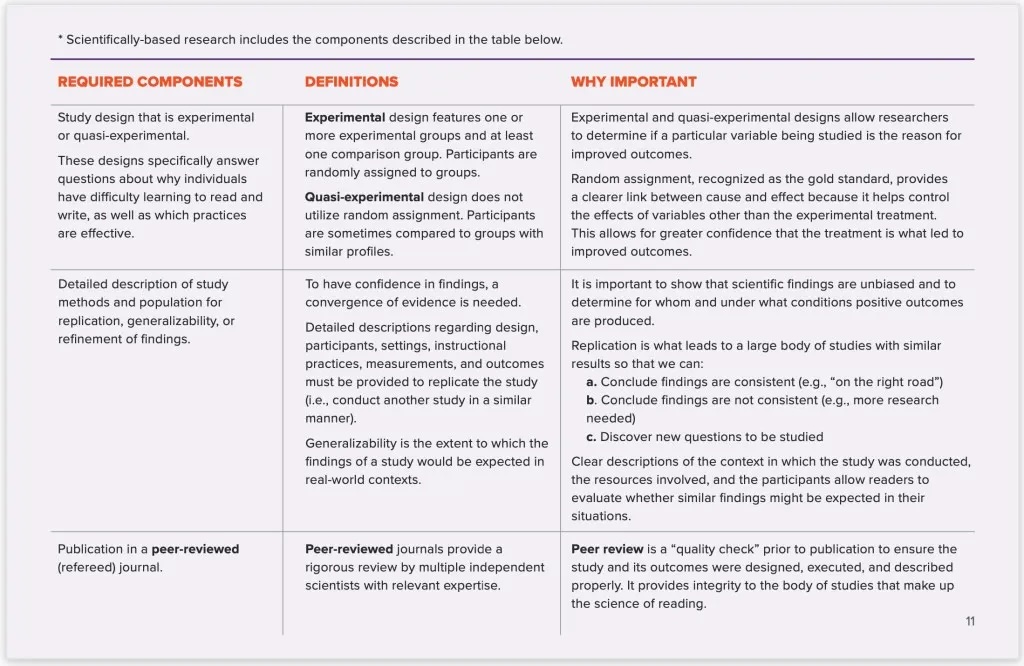
Both the think tank report and the proposed legislation fail even the minimal requirements of what should count as “science” in education research (as endorsed by The Reading League):
NCTQ Reports: Ideological not Scientific
The National Council on Teacher Quality (NCTQ) was established in 2001 by the Thomas B. Fordham Institute, a conservative think tank dedicated to free market ideology.
NCTQ has an anti-teacher education agenda that all of their reports confirm, regardless of the data or the methodology (this parallels decades of school choice and charter school research by conservative think tanks).
For research to be scientific, it must be experimental or quasi-experimental in methodology; however, NCTQ reports on teacher education tend to be analyses of course syllabi, surveys, and a great deal of citations to sources that are not scholarly (podcasts, media articles, blog posts, etc.).
For example, when I began my review of a 2023 NCTQ report, I took the time to interrogate the 90% claim made in the report: “With effective reading instruction, we could take that [student reading proficiency] to more than 90%” (p. 4)
That claim by NCTQ has a footnote to a few studies, but the most interesting evidence is the final citation to a blog post by Nathaniel Hansford.
Hansford analyzes the claim and finds the science lacking:
Some of the citations I was sent were policy papers, by authors and institutions that used this claim. However, these papers were not experimental and usually cited popular Science of Reading books, not experimental research. There was also, interestingly, one research paper sent to me from the 1980s, that made the claim, but did not cite any evidence to support it. So it appears that this claim has been in circulation for a long time. The most common source listed for this claim seemed to be Louisa Moats, who has written about this rule on numerous occasions. However, she does not claim that 95% of students can reach grade level, based on just core instruction, but rather in totality. Louisa Moats cites 4 sources in support for this rule. In Kilpatrick’s book Essentials of Assessing, Preventing, and Overcoming Reading Difficulties; a 2009 paper by Lim, et al. on students with Down Syndrome; a 2005 paper by Mathes, et al, examining the rate of risk reduction for struggling reading, with intensive intervention instruction, and a literature review of risk reduction, by Joseph Torgersen. In my opinion, the last two citations provide some experimental evidence to support this claim.
Not only are the methodology and citations unscientific, but the reports are not peer-reviewed before being published. And, once they are reviewed, several external reviews have found the reports lack credibility:
- Dudley-Marling, C., Stevens, L. P., & Gurn, A. (2007, April). A critical policy analysis and response to the report of the National Council on Teacher Quality (NCTQ). NCTE. https://ncte.org/resources/reports/critical-policy-analysis-response-nctq-report/
- Benner, S. M. (2012). Quality in student teaching: Flawed research leads to unsound recommendations. Boulder, CO: National Education Policy Center. https://nepc.colorado.edu/thinktank/review-student-teaching
- Fuller, E. J. (2014). Shaky methods, shaky motives: A critique of the National Council of Teacher Quality’s review of teacher preparation programs. Journal of Teacher Education, 65(1), 63-77. https://journals.sagepub.com/doi/10.1177/0022487113503872
- Cochran-Smith, M., Stern, R., Sánchez, J.G., Miller, A., Keefe, E.S., Fernández, M.B., Chang, W., Carney, M.C., Burton, S., & Baker, M. (2016). Holding teacher preparation accountable: A review of claims and evidence. Boulder, CO: National Education Policy Center. http://nepc.colorado.edu/publication/teacher-prep
- Cochran-Smith, M., Keefe, E.S., Chang, W.C., & Carney, M.C. (2018). NEPC Review: “2018 Teacher Prep Review.” Boulder, CO: National Education Policy Center. http://nepc.colorado.edu/thinktank/review-teacher-prep-2018
- Burke, K. J., & DeLeon, A. (2020). Wooden dolls and disarray: Rethinking United States’ teacher education to the side of quantification. Critical Studies in Education, 61(4), 480-495. https://www.tandfonline.com/doi/abs/10.1080/17508487.2018.1506351
- Stillman, J., & Schultz, K. (2021). NEPC Review: “2020 Teacher Prep Review: Clinical Practice and Classroom Management.” Boulder, CO: National Education Policy Center. http://nepc.colorado.edu/thinktank/teacher-prep
- Thomas, P.L., & Goering, C.Z. (2016). Review of “Learning about Learning: What Every New Teacher Needs to Know.” Boulder, CO: National Education Policy Center. http://nepc.colorado.edu/thinktank/review-teacher-education
- Thomas, P.L. (2023, September). NEPC review: Teacher prep review: Strengthening elementary reading instruction. Boulder, CO: National Education Policy Center. https://nepc.colorado.edu/review/teacher-prep
- Aydarova, E. (2026). NEPC Review: Decoding progress in reading preparation. Boulder, CO: National Education Policy Center. Retrieved [date] from https://nepc.colorado.edu/review/reading-prep
READ Act: Based on a Misleading Reading Story, not Science
The READ Act is grounded in a report on literacy from U.S. Senator Bill Cassidy, M.D. (R-LA) that opens with yet another example of misrepresenting NAEP reading scores to manufacture a reading crisis for political gain: “Two-thirds of America’s fourth and eighth graders are not proficient in reading.”
The report is an embarrassing recycling of the media misinformation campaign about reading in the US.
In fact, most of the footnotes cite news articles (including the Washington Times, a conservative outlet that lacks credibility) and conservative think tanks (ExcelinEd, Fordham).
Notably missing are citations to scientific research on reading or credible analyses of NAEP data.
Here is my analysis of 33 footnotes for the report that lays the groundwork for the reading bill now being proposed (championed by a medical doctor, not an educator):
Preventing a Lost Generation: Facing a Critical Moment for Students’ Literacy
Senator Bill Cassady, MD, Ranking Member
US Senate Committee on Health, Education, Labor, and Pensions
NAEP/PISA Data/ Government Reports
- National Achievement-Level Results, National Assessment of Educational Progress (Oct. 24, 2022), https://www.nationsreportcard.gov/reading/nation/achievement/.
- National Achievement-Level Results, The National Assessment of Educational Progress (Oct. 24, 2022), https://www.nationsreportcard.gov/reading/nation/achievement/.
- Trends in High School Dropout and Completion Rates in the United States, National Center for Education Statistics (Jan. 2020), https://nces.ed.gov/programs/dropout/index.asp.
- Thomas G. Sticht, Vice President, Basic Skills in Defense, Human Resources Research Organization (June 1982), https://files.eric.ed.gov/fulltext/ED237776.pdf.
- Scores Decline in NAEP Reading at Grades 4 and 8 Compared to 2019, National Assessment of Educational Progress (Oct. 24, 2022), https://www.nationsreportcard.gov/highlights/reading/2022/
- NAEP Report Card: 2019 NAEP Reading Assessment, National Assessment of Educational Progress (2019), https://www.nationsreportcard.gov/highlights/reading/2019/g12/.
- NAEP Long-Term Trend Assessment Results: Reading and Mathematics, National Assessment of Educational Progress (Sept. 1, 2022), https://www.nationsreportcard.gov/highlights/ltt/2022/.
- Program for International Student Assessment 2022 Results, Organization for Economic Cooperation and Development (Dec. 5, 2023), https://www.oecd.org/publication/pisa-2022-results/.
- AEP Report Card: Reading State Achievement-Level Results, National Assessment of Educational Progress (Oct. 24, 2022), https://www.nationsreportcard.gov/reading/states/achievement/.
- Teaching Children to Read: An Evidence-Based Assessment of the Scientific Research Literature on Reading and Its Implications for Reading Instruction, National Reading Panel (Apr. 2000), https://www.nichd.nih.gov/sites/default/files/publications/pubs/nrp/Documents/report.pdf.
- National Achievement-Level Results, National Assessment of Educational Progress (Oct. 24, 2022), https://www.nationsreportcard.gov/reading/nation/achievement/.
- NAEP Long-Term Trend Assessment Results: Reading and Mathematics, National Assessment of Educational Progress (Sept. 1, 2022), https://www.nationsreportcard.gov/highlights/ltt/2022/.
- Joint Dear Colleague Letter, U.S. Department of Education Office for Civil Rights (Jan. 8, 2014), [LINK OMITTED, apparent error]
- Resource on Confronting Racial Discrimination in Student Discipline, U.S. Department of Education Office for Civil Rights (May 2023), https://www.justice.gov/opa/press-release/file/1585291/dl?inline.
Think Tank/Advocacy Reports
- Donald J. Hernandez, Professor, Double Jeopardy: How Third-Grade Reading Skills and Poverty Influence High School Graduation, The Annie E. Casey Foundation (2012), https://assets.aecf.org/m/resourcedoc/AECF-DoubleJeopardy-2012-Full.pdf.
- Anthony P. Carnevale et al., Director and Research Professor, Recovery: Job Growth and Education Requirements Through 2020, Georgetown Public Policy Institute – Center on Education and the Workforce (June 2013), https://cewgeorgetown.wpenginepowered.com/wp-content/uploads/2014/11/Recovery2020.FR_.Web_.pdf
- Economic Impacts of Dropouts. National Dropout Prevention Center (n.d.), https://dropoutprevention.org/resources/statistics/quick-facts/economic-impacts-of-dropouts/.
- Erin Fahle et. al, Research Scientist, The First Year of Pandemic Recovery: A District-Level Analysis, The Harvard University Center for Education Policy and Research & The Educational Opportunity Project at Stanford University (Jan. 2024), https://educationrecoveryscorecard.org/wp-content/uploads/2024/01/ERS-Report-Final-1.31.pdf.
- Why The Three-Cueing Systems Model Doesn’t Teach Children to Read, Excel in Ed (2022), https://excelined.org/wp-content/uploads/2022/12/ExcelinEd_FactSheet_ThreeCueingDoesNotTeachChildrenToRead.pdf.
- 2023 Voice of the Superintendent Survey Executive Brief, EAB (Feb. 16, 2023), https://pages.eab.com/2023SuperintendentSurveyExecutiveBrief.html.
- Daniel Buck, Soft-on-Consequences Discipline Is Terrible For Teachers, Thomas B. Fordham Institute (Feb. 9, 2023), https://fordhaminstitute.org/national/commentary/soft-consequences-discipline-terrible-teachers.
- Max Eden, The Trouble with Social Emotional Learning, House Committee on Appropriations – Labor, Health and Human Services, Education, and Related Agencies (Apr. 6, 2022) AEI, https://www.aei.org/research-products/testimony/the-trouble-with-social-emotional-learning/.
- Chronic Absenteeism: 2017-2023, Return2Learn Tracker (Oct. 23, 2023), https://www.returntolearntracker.net/
Media
- Micaela Burrow, Army Qualification Test Scores Plummeted Further In 2022, Daily Caller. (Sept. 16, 2022). https://dailycaller.com/2022/09/16/army-qualification-scores-plummeted-2022/.
- April Rubin, ACT Test Scores Fall to Lowest Levels in 32 Years, Axios (Oct. 11, 2023), https://www.axios.com/2023/10/11/act-test-scores-lowest-2023.
- Matt Barnum & Kalyn Belsha, Blizzard of State Test Scores Shows Some Progress in Math, Divergence in Reading, Chalkbeat (Oct. 2, 2023), https://www.chalkbeat.org/2023/10/2/23896045/state-test-scores-data-math-reading-pandemic-era-learning-loss.
- Linda Jacobson, Science of Reading Push Helped Some States Exceed Pre-Pandemic Performance, The 74 Million (Oct. 17, 2023), https://www.the74million.org/article/science-of-reading-push-helped-some-states-exceed-pre-pandemic-performance/.
- Liana Loewus, Data: How Reading Is Really Being Taught, Education Week (Dec. 3, 2019), https://www.edweek.org/teaching-learning/data-how-reading-is-reallybeing-taught/2019/12.
- Sarah Schwartz, Teachers College to ‘Dissolve’ Lucy Calkins’ Reading and Writing Project, Education Week (Sept. 5, 2023), https://www.edweek.org/teaching-learning/teachers-college-to-dissolve-lucy-calkins-reading-and-writing-project/2023/09.
- Sarah Schwartz, Reading Recovery Sues Ohio Over Ban on ‘Cueing’ in Literacy Instruction, Education Week (Oct. 18, 2023), https://www.edweek.org/teaching-learning/reading-recovery-sues-ohio-over-ban-on-cueing-in-literacy-instruction/2023/10.
- Susan Ferrechio, Teachers Unions Worked with CDC to Keep Schools Closed for COVID, GOP Report Says, The Washington Times (Mar. 30, 2022), https://www.washingtontimes.com/news/2022/mar/30/republican-report-shows-teachers-unions-helped-cdc/.
- Sarah D. Sparks, Two Decades of Progress, Nearly Gone: National Math, Reading Scores Hit Historic Lows, Education Week (Oct. 24, 2022), https://www.edweek.org/leadership/two-decades-of-progress-nearly-gone-national-math-reading-scores-hit-historic-lows/2022/10.
- Arianna Prothero, Student Behavior Isn’t Getting Any Better, Survey Shows, Education Week (Apr. 20, 2023), https://www.edweek.org/leadership/student-behaviorisnt-getting-any-better-survey-shows/2023/04.
- Sarah Mervosh, Who Runs the Best U.S. Schools? It May Be the Defense Department., The New York Times (Oct. 10, 2023), https://www.nytimes.com/2023/10/10/us/schools-pandemic-defense-department.html.
Commercial Blogs
- TPT Survey Report: What 2,000+ Teachers Think About SEL, Teachers Pay Teachers (May 2022), https://blog.teacherspayteachers.com/tpt-survey-report-what-2000-teachers-think-about-social-emotional-learning/.
Another important point is that Senator Cassidy and his wife are financially invested in charter schools focusing on dyslexia—and that isn’t going so well:
A school for students with dyslexia continues to stay open despite two F grades from the BESE, Louisiana’s Board of Elementary and Secondary Education. The Louisiana Key Academy is run by Senator Bill Cassidy (R-LA) and his wife, Laura. Both are physicians. Neither are specialists in reading disorders, although they have a child with dyslexia.
The “science of reading” movement is mostly ideology and politics, and we are left with a question that doesn’t seem to resonate as well as those old Wendy’s commercials—but should: Where’s the science?
This blog post has been shared by permission from the author.
Readers wishing to comment on the content are encouraged to do so via the link to the original post.
Find the original post here:
The views expressed by the blogger are not necessarily those of NEPC.